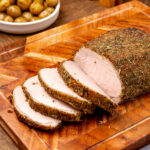
Herb Crusted Pork Loin {Juicy, Tender, and Foolproof}
This herb crusted pork loin is juicy and tender inside with a flavor-packed golden crust on the outside. A Dijon butter coating locks pantry spices into a real crust, and a two-temp roast keeps the inside perfectly tender.
Servings: 4
Ingredients
- 1 Pork Loin Roast 3-4 pounds
- 2 tsp kosher salt
- 1 tsp black pepper
- 1 ½ tsp onion powder
- 1 ½ tsp garlic powder
- 2 ½ tsp Italian seasoning
- 1 ½ tsp thyme dried
- ½ tsp rosemary dried
- 1 tsp parsley flakes dried
- 1 tbsp Dijon mustard
- 2 tbsp butter melted
Instructions
- Preheat oven to 425°F. Line a sheet pan or baking dish with aluminum foil and lightly spray with nonstick spray.
- In a small bowl, combine kosher salt, black pepper, onion powder, garlic powder, Italian seasoning, thyme, rosemary, and parsley flakes.
- Trim any excess fat from the pork loin if needed, but leave the fat cap on top. Pat the roast dry with paper towels.

- Microwave the butter in a small dish for about 1 minute, or until melted. Whisk in the Dijon mustard.
- Rub the Dijon butter all over the pork loin, covering the top, sides, and ends.
- Sprinkle the seasoning mixture over the entire roast, pressing gently to help it adhere. Get the sides and ends too.

- Place the pork fat side up on the prepared pan. Roast at 425°F for 15 minutes, uncovered.
- Reduce heat to 375°F and continue roasting uncovered for 45-60 minutes, or until the internal temperature reaches 140°F in the thickest part of the roast.

- Remove from the oven and tent loosely with foil. Let rest, undisturbed, for 10 minutes. The internal temperature will rise to 145°F.
- Slice across the grain into ½-inch slices and serve.

Video
Notes
- Pull at 140°F, not 145°F. The roast carries over to 145°F during the rest, which is the USDA-recommended safe temp for pork.
- An instant-read thermometer is the only reliable doneness signal. Cook time varies by roast size, oven calibration, and starting temperature.
- Patting the roast dry and using the Dijon butter base is what makes the crust stick. Don't skip either step.
- Press the seasoning firmly into the Dijon butter coating so it forms a real crust instead of falling off in the pan.
- Roast uncovered the entire time. Covering steams the roast and softens the crust.
- For fresh herbs, swap in about 1 tablespoon each of finely chopped fresh rosemary and thyme in place of the dried versions.
- This recipe is built for a 3-4 pound boneless pork loin roast. Pork tenderloin is a different cut and cooks much faster.
- Rest a full 10 minutes before slicing. Cutting in early lets the juices run out onto the board instead of staying in the meat.